


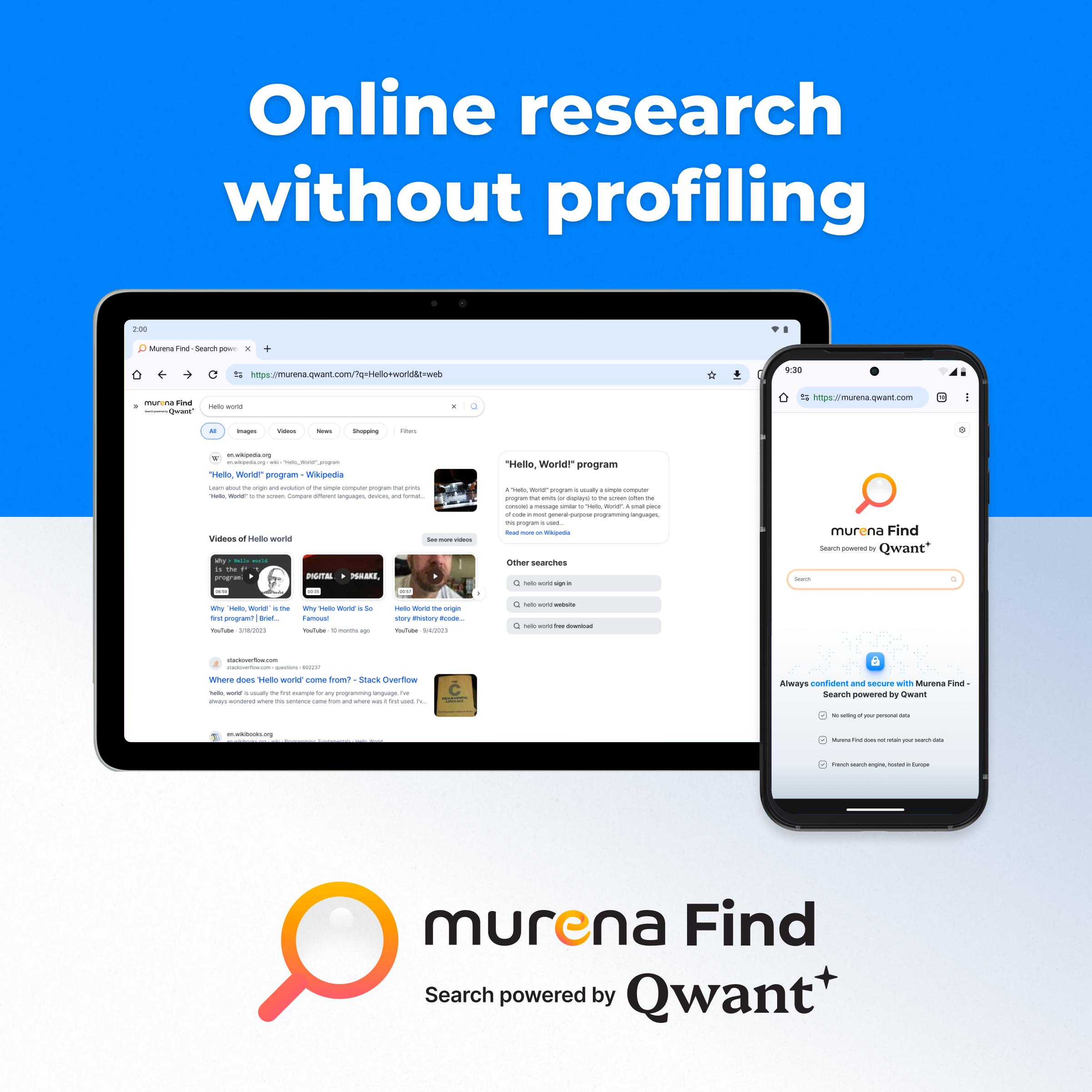
Murena Find: Online research without profiling
“I don’t know – ask Google” – an answer you’ve probably already heard more than once in your life.
In this article we explain what happens when you do so and why you should consider more ethical search engines like Murena Find. You can use Murena Find, based on Qwant, in your browser, within your Murena Workspace account and on your Murena smartphone running /e/OS.
How do mainstream search engines work?
Mainstream search engines analyze your query, then instantly return results from their pre-built index, which is a massive database of websites, ranked by algorithms. But this “free” service comes with hidden costs: your data.
Big Tech search engines like Google use cookies and other tracking technologies to store your surfing habits. Cookies transmit data such as your location, IP address, browser type, language, and unique identifiers – sometimes even to third parties interested in your online behavior.
A good example of a unique identifier is the Google Advertising ID (GAID). It’s a user-level identifier assigned to Android devices that allows advertisers to track user behavior across different apps and websites to deliver personalized ads and measure campaign effectiveness. This means that the identifier links activities within the device’s ecosystem. It enables the creation of a profile that easily connects individuals to the locations where they are.
As Le Monde reports*, journalists were even able to identify the business owned by the wife of a special forces member and – perhaps even more concerning – his child’s school via his device. While GAID is designed to be resettable by the user, an average user neither thinks about these privacy concerns, nor has the technical knowledge to find their way in obscure settings.To help users without advanced technical knowledge protect their privacy, we offer Murena smartphones already running /e/OS. This privacy-friendly operating system does not include Google services and therefore does not include GAID.
According to Google’s official documentation, they collect:
- Your web requests (searches, clicks),
- IP address, browser details, timestamps, and
- Advertising cookies (including third party cookies if enabled), all to profile you for maximum profit.
The collected data is often sold to brokers or combined with other datasets. As shown by Le Monde*, journalists could pinpoint not just addresses, but even specific rooms in homes of device owners by piecing together such data.
The hidden dangers of hyper personalized search: beyond privacy risks
When you do an online research, the first things you see are ads – not the most relevant results. While they must be labeled, the labeling is often subtle and easily overlooked.
Then, based on your collected data, the rest of the results appear. Personalization might seem useful, but it comes with serious downsides:
- Your data is stored – often in countries with weaker privacy laws than yours.
- More third-party access = higher risk of leaks or misuse.
- Filter bubbles create blind spots, hiding diverse perspectives.
- Bias in results: Different users see different prices, job offers, or information – not because of relevance, but because of profiling.
Apart from the above-mentioned downsides, storing data in foreign countries can lead to sovereignty issues – as seen in the case of Nicolas Guillou and other International Criminal Court (ICC) members**. After the US imposed sanctions on ICC judges, Guillou was cut off from US-based digital services (like Amazon, Airbnb, and banking systems), highlighting that dependence on other governments can become a problem more quickly than one might think.
A solution for more ethical, privacy-respecting online research
Now that you know more about the downsides of mainstream search engines – imagine the perfect privacy-respecting search option: no profiling, little or no ads, and precise yet neutral results that avoid reinforcing bias, right?
Ideally, it should be easily accessible – not only in your browser, but also on your smartphone.
To turn this vision into reality, we teamed up with Qwant. Unlike mainstream search engines, Qwant does not store or analyze your searches, protecting your data and preventing filter bubbles. Together with the German search engine Ecosia, Qwant is working on its own search index. They aim to host all this information, algorithms and codebase on EU-based servers, so no foreign government will be able to disrupt its services.***
A privacy-friendly online search experience with Murena Find
By partnering with Qwant, Murena has not only enriched the Murena ecosystem, but also improved a key tool for online users:
- When using Murena Find on your Murena smartphone, your privacy is enhanced by our Advanced Privacy app, which blocks metadata transfer before any website can analyze it.
- Murena Find is accessible with one click from your Murena Workspace account.
- And, of course, it works seamlessly in your favorite browser – whether you’re already a Murena customer or not.
What’s your favorite search engine and why? We’d love to hear your thoughts!
Try Murena Find today
**https://www.heise.de/en/news/How-a-French-judge-was-digitally-cut-off-by-the-USA-11087561.html
Leave a Reply